Pages

Friday, August 8, 2014

Ten Worrying Signs for Private SME-s

These are typical symptoms for an organization that is not prepared to evolve in ascending direction. It may not go downward, but it will certainly experience difficulties growing beyond its current level:
  1. Succession at the top is based on criteria other than merit and competency. Family ties are the most common illustration of such compromise.
  1. People nominated to formal leadership positions (titles) are not identified with the core business (i.e. Sales people promoted at the top of a manufacturing company, Lawyers driving a distribution business, Accountants leading a sales organization)
  1. Executive positions are occupied by B people. The danger is not as much in their mediocrity, but in their tendency to surround themselves with C people.
  1. Company website is used as a Facebook page, for self promotion of the ownership – examples are pictures taken with celebrities, or outside the relevant business context (family events, birth celebrations, etc.)
  1. Too much emphasis is put on the “family controlled” character of the business. Such attribute may be liked by other small, family-run businesses, but raises suspicions in the eyes of larger, professionally managed organizations, or other supporting entities (banks, legal representation, Government offices).
  1. Preoccupation with personal image is more prominent than meeting the core business objectives. Excuses are accepted, and compromises are made, when they facilitate projecting a better light, or help hiding mistakes.
  1. Outside consultants become the preferred source of advice, and are working directly for the person at the top, ignoring the management.
  1. Direct lines of communication are maintained between ownership and lower level employees, circumventing the hierarchy – People are solicited for personal services (taking kids to school, deliveries to home address, repairing something at the family cottage, changing car tires etc.)
  1. Small, short-term objectives, perceived as associated with owner’s interest, are allowed to take precedence over established processes and principles – Statements like “Doing the right things is more important than doing things right” are deceiving when not aligned with business fundamentals. 
  2. Too much attention is given to the messenger, as opposed to those contributing to the substance of the message – people will make an effort to create positive messages of non-relevant nature, will rush to be the first to deliver them, and will take undue credit.

Thursday, August 15, 2013

The Inspirational Value of Analogy in Business

As a modern occupation, business management tries to establish links with other, more traditional domains of life, where acceptable conventional wisdom is available to inform the target audience. When it comes to communicating and transferring theoretical knowledge, especially for abstract or new content, nothing works better than analogies. There are two frequently referenced sources of inspiration: sports and military.

A significant portion of the business vocabulary has been imported from the world of sports. It is an easy construct, given the competitive nature of the two environments, as well as the wide resonance of such examples with most people, based on the popularity of sports.

For illustration, there are some sound similarities:
  • Accomplishments are typically the result of team effort.
  • Extensive practice is the mother of success (Malcolm Gladwell – Outliers – empirical findings placed the threshold at approx. 10,000 hrs – about 10 years)
  • Results are measurable in increments – score in sports; Balance Score Cards, Key Performance Indicators, or simply $ in business
However, by constructing a frame of reference in the sports arena, many times we distort substantially the reality of the business context. Hence, for every comparable trait, there is a dissonant aspect. Here are some typical examples:

  • Objectives
    • In sports - the focus object is one ball or puck
    • In business - there are multiple, simultaneous objectives
  • Purpose
    • The purpose of competition is to test the limits or to win a game, with some entertainment value
    • Most of the time, business success is a survival mechanism
  • Rules
    • In sports - rules are significantly more rigid and well defined
    • Due to the number of variables at play, the business playing field is a lot more complex
  • Drivers for success
    • The individual talent is the main ingredient of sport team’s success
    • In business - too much emphasis on the individual merits may be a deterrent for collective accomplishment, while collaboration is the catalyst for success
  • Ability to intervene and apply corrections
    • In sports - there is a referee on the ground, who intervenes and stops the game every time there is a fault play
    • In business - the real judge is the marketplace, and the reaction is delayed
  • Last, but not least relevant, members of a business entity (with the exception of glorified CEO-s) are paid for their performance much less than the star athletes whose stories are used to inspire organizational behavior.

A second remarkable parallel - that got immense attention and interest in business circles - was triggered by the rediscovery of “The Art of War” – brilliantly articulated by Sun Tzu, around 500 bc. Words like strategy, tactics, targets, officers, soldiers, strengths, weaknesses and winning have received a new dimension when extrapolated in the context of a business entity. It is undeniable that this learning is valuable, primarily in times of crises and tensed circumstances. However, the business reality is not always analogous to war, and the daily routine rarely compares with the strains of a military campaign.

Without diminishing the inspirational value of the two previous frames of reference, I find increasing relevance in the world of music played in concert halls, a field that could be equally vibrant, but resorting to means of expression that are significantly different from the energy and sacrifice found in the athletic arenas or battle trenches. Therefore I began to see the nature and purpose of a functioning organization more like an orchestra, rather than as a sports team, or an army of generals and soldiers.

We don’t need to look through special lenses to find the obvious resemblance. The immediate source of information would be a simple on-line research, where Wikipedia defines it for us, in fairly adequate language:

  • An orchestra is a large instrumental ensemble that contains various sections of strings, brass, woodwind, and percussion instruments.
  • Orchestras are usually led by a conductor who directs the performance… unifies the interpretation across various sections, sets the tempo and shapes the sound of the ensemble.
  • Members play different instruments – with remarkable skills and abilities – but the collective goal is harmony not individual prominence.

Let’s proceed now by slightly changing just few words, with their equivalent in an organizational setting.  You’ll be amazed how business-suitable this is.

  • A business unit is a large resource center that contains various departments of technical, commercial, production and administrative functions.
  • Business Units are usually led by a Manager who directs the activity… unifies the execution across various departments, sets the objectives and shapes the output of the ensemble.
  • Members play different roles – with remarkable skills and abilities – but the collective goal is organizational success not individual prominence.
 

I can certainly use this view, and be perfectly in tune with the image it portrays for my corporate target audience. So let’s continue to play this chord and delve into the role of management in this context. There are valuable lessons to be learned from the work of a conductor, as my next blog will suggest…

Wednesday, August 14, 2013

Conductors and Managers - Highly Correlated Roles

Conducting is the act of directing an artistic performance, such as a musical concert, by means of communicating artistic directions to performers during a performance (directly or subliminally). * Source note: Wikipedia.

The primary responsibilities of the Conductor are to unify performers, set the tempo, execute clear preparations and beats, listen critically and shape the sound of the ensemble, and to control the interpretation and pacing of the music.

Conductors act as guides to the orchestras and/or choirs they conduct. They choose the works to be performed and study their scores to which they may make certain adjustments (e.g. regarding tempo, repetitions of sections, and so on), work out their interpretation, and relay their vision to the performers. They may also attend to organizational matters, such as scheduling rehearsals, planning a concert season, hearing auditions, and promoting their ensemble in the media.

Among most common conducting techniques:

Although there are many formal rules on how to conduct correctly, others are subjective, and a wide variety of different conducting styles exist, depending upon the training and sophistication of the conductor.

Communication is non-verbal during a performance; however in rehearsal frequent interruptions allow directions as to how the music should be played. During rehearsals, the conductor may stop the playing of a piece to request changes in the phrasing or suggest a variation in the timbre of a certain section. In amateur orchestras, the rehearsals are often stopped to draw the musicians' attentions to performance errors or transposition mistakes.

Conducting requires an understanding of the elements of musical expression (tempo, dynamics, and articulation) and the ability to communicate them effectively to an ensemble (cues). The capacity to inoculate nuances of phrasing (intensity, gradient) and expression (attitude) through gestures is also beneficial. Conducting gestures are preferably prepared beforehand by the conductor while studying the score, but may sometimes be spontaneous.

Of all conducting techniques, I consider cueing being one of the most important. It relates to anticipation, being ahead of the game, seeing around the corner and all other qualities that distinguish leaders from followers.

*************************************************************************

Managing is the act of directing a business performance, such as a manufacturing process, by means of communicating technical directions to performers during the operations (directly or subliminally).

The primary responsibilities of the Manager are to unify subordinates, set the agenda, execute clear preparations and plans, observe critically and shape the output of the ensemble, and to control the budget and timely completion of the work.

Managers act as guides to the departments or companies they manage. They choose the opportunities to be serviced and study their requirements to which they may make certain adjustments (e.g. regarding priorities, resource allocations, and so on), work out their implementation plan, and relay their vision to the performers. They may also attend to organizational matters, such as scheduling reviews, planning a business cycle, recruitment and training, and promoting their company in the market.

Among most common managing techniques:

Although there are many empirical rules on how to manage correctly, others are subjective, and a wide variety of different managing styles exist, depending upon the training and sophistication of the manager.

Communication is less intense during the execution; however in planning and training phases frequent interactions allow directions as to how and when the work should be performed. During project reviews, the manager may stop the presentation of a plan to request changes in the process or suggest an alternative solution. In low automated work-centres, the processes are often stopped to draw the operators' attentions to performance issues or quality mistakes.

Managing requires an understanding of the elements of business nature (time, expectations, cost) and the ability to communicate them effectively to an organization (cues). The capacity to inoculate a sense of urgency (sequence, priorities) and commitment (attitude) through personal example is also beneficial. Managing actions are preferably planned beforehand by the manager while studying the scope, but may sometimes be spontaneous.

Of all managing mandates, I consider prevention being one of the most important. It relates to anticipation, being ahead of the game, seeing around the corner and all other qualities that distinguish leaders from followers.

 
************************************************************************
 

Remember, the main purpose of a musical performance is harmony, not individual prominence! The same should be valid in business!

I rest my case…

Thursday, September 27, 2012

Virtues and Sins

In my management practice, I sometimes come across people stating emphatically: “I am not really a detail guy; I am a big-picture kind of person”. What that translates into my ears is: “I can’t be bothered with the responsibility of the end result, I prefer to remain in the clouds, by looking at things from above, with a pretense of seeing into the future, expressing my idealistic dreams and pretending they make up for a vision”. Does it sound familiar? Here is my take on such individuals:


We all despise truth distortion, or narrative spinning, mainly when it’s done for the perverse gain of the story teller. But I have to admit, I am mesmerized by the ability of some speakers to pretend that a sin could be construed as a virtue. Most of the time these are people that are, otherwise, failing miserably at either getting anything done, or articulating a plan of action, or managing the execution of any enterprise. And yet, they are trying to repackage these shortcomings by branding them as a superior quality.

When you are a true leader of an organization, this attitude needs to be discouraged and the promoters put in their place through a reality check. They need to understand that they are not living in a heavenly cloud, and that life is made out of details that are important. If the details are neglected – most of the time because we don’t know how, or just not comfortable dealing with them – those high-level ideas will amount to nothing more than a series of unfulfilled prophecies.

No High-Tech star has been more visionary – in the recent past – than Steve Jobs; imagining new devices and technological features, way before any consumer or user would have been able to formulate such need, was really genial. Other players in the filed may claim an equal or greater creativity, but what made the difference was also his ability to focus on details and be very specific and selective about the characteristics embedded into such devices. That’s how the novelty of his ideas materialized into concrete, successful applications, adored by the fans and valued by the masses.

If you ask any pilot, which part of the flight is the most challenging, and therefore more probing of true pilot qualities, they will all tell you that it is not the cruising at high altitude, and is not even the take-off, but it is the landing. There is where you are confronted with multiple variables at play, with most adverse circumstances and critical conditions. The ability to always put a plane on the ground smoothly and safely is what distinguishes amateurs from professionals. Dreaming is easy when there is no direct accountability test. Implementing a vision into a solution is what separates doers from talkers.

So in the enterprise management arena, next time you hear somebody communicating a 10,000 ft picture of things, ask them to provide a more concrete, down-to-earth, step-by-step vision of their idea. If it makes sense to you, ask them to take charge and carry it onto the implementation phase, and then measure and interpret the results. Upon analysis, some will be successful due to real qualities and comprehensive capabilities. But many will fail and disappoint, and such you’ll learn a lesson on how to recalibrate credibility, by recognizing the value of facts versus words, or of real virtues versus disguised sins.

Saturday, September 25, 2010

Street-Smart versus Book-Smart

In my day to day activity I am increasingly confronted with a new burden: the need to work, communicate and maintain a balance of influence among groups of individuals that are framed as either street-smart or book-smart.  I admit, I struggle with the idea that one is more important than the other. In a society that is increasingly influenced by perceptions and is more connected at a superficial (virtual) level, empirical evidence suggests that street-smart people are doing better, are more prominent and more adapt to the current trends. However, I believe that both types have beneficial influences over the impacted audience.

The way I define this reality is by looking at it from different perspectives:

Book-Smart People                      Street-Smart People

Concerned with Substance            Concerned with Form
Create knowledge                           Able to relate information
Understand the principles              Figure out the application
Generate solutions                          Amplify ideas
Learn through formal education     Learn through observation
Know a lot about few things          Know little about a lot of things
Invent new things                            Innovate and improve
Higher IQ                                         Higher EQ

It is easy to get mesmerized by the ability with which Street-Smart people exploit opportunities in life, by impressing audiences with their extensive “know-what, know-how and know-who”. However, leaders and managers in authoritative positions are frequently confronted with the need to discern between information that is made available to them by Street-Smart versus Book-Smart subordinates. The mission of good management is to separate the real information in the message from the noise.
 
And there is considerable noise in the system;
   • created by unverified or exaggerated information,
   • embedded into the signal through misinterpretation or distortion
   • multiplied through repetition and extrapolation
   • strengthened by buzz-words and name-dropping
   • hidden under the umbrella of charisma and enthusiasm
   • reinforced by bullies and laud, energetic promoters

The unfortunate property of the signal amplifiers is that they magnify indiscriminately the whole wave sound, with all the useful as well as twisted components. There is no distinction between fact and hearsay, between reality and appearance, or between truth and distortion. That is why probing and testing of information accuracy is needed more than ever, in a world where verbal and written interaction has become so intense - due to the mobile, virtual and personal features of the communication tools – and the people are overwhelmingly interconnected.

So what I propose is an analogy with the electronics systems where the useful signal is generated by the Book-Smarts, is amplified and transmitted by the Street-Smarts and filtered and interpreted at the other end by the wise and experienced Manager. The filtering could be done either at the emitting point – although transmission could inject additional noise – or at the receiving end. The trick is to correctly identify the quality of the source, the character of the communicators in the channel, and the motivation of the interpreter.

Saturday, August 7, 2010

The Role of Management

After spending a good portion of my professional life in management structures, I arrived to the conclusion that the fundamental role of management is to anticipate, assess and mitigate risk.


In absence of risk there is no need for management. I know, some will argue that any activity needs coordination and administration and therefore, it requires management. But isn’t that just another manifestation of risk?

Let’s assume an ideal operating environment that is self running. It has only a leader (owner) and an army of executants (employees).
• One day an employee does not show up for work and the owner realizes that there is a risk of that happening from time to time, among the employee population. Consequently he nominates an HR Manager to deal with the absenteeism.
• Another time the material needed for processing does not arrive, because of some supply problem; so he designates a Purchasing Manager to ensure that the material is ordered and received on time, and procured at the right prices.
• The products are ready for delivery now, but the truck hasn’t been called to pick it up; woops, there is a need for a Logistics Manager
• Opportunities for business present themselves in an irregular sequence, and the assignment of work among co-workers needs to be changed daily  a Production Manager is put in charge to coordinate the allocation of resources
• Customers are interested in the product but they want to talk to somebody where they could place their orders or learn about the product. Technically the orders could be recorded by phone or e-mail, and the reading of the brochure should provide enough information, but faced with the risk of loosing customers or orders because of lack of response the owner nominates a Sales Manager
• The PO suggests when the customer wants the product, but for some reason, the project activities are not happening according to plan  the risk of not finishing the project on time – unless properly coordinated - gives enough reason for the existence of a Project Manager
• Finally, the product is shipped and invoiced, but the payments are delayed, and the bank is raising questions about the overdraft level in the company’s account. That is when the Controller justifies its position.

The image is pretty clear: In the minute an enterprise is born, there are inherent risks that are threatening the ability of the firm to perform well and make profits. The capacity of the company to generate results is guarded against risks by this institution of Management, whose primary role is to anticipate probable scenarios, evaluate risk exposure, analyze possible consequences, develop solutions and implement plans, structures and processes, measure results and devise reward systems to ensure continuous success. In spite of these efforts, risk does not totally evaporate, but – when things are done well - is minimized.

Once accepted as an objective need, the management expands, gaining legitimacy and consolidating its new platform called “Overhead”. In time, the merits of its contribution are gradually diminished to a point where is perceived as non-value-added, or burden. And from there, in the name of “lean transformation” a process of constructive demolition begins, until the necessary managerial safeguards are no longer in place. Then something happens and the negative impact of such occurrence exceeds by far the cost of its prevention. Instantly we realize the value of risk management and are willing, again, to dedicate resources to it.

However, by now we went full circle, and the history repeats itself.

Does it sound familiar? It should, because is happening everywhere. And emerging from it, an entire army of management consultants make a living.

Saturday, May 15, 2010

Financial Regulation - A Common Sense Solution

There are days when complicated issues come on display in a different light, and, suddenly, they look much simpler. It recently occurred to me that the problem with the financial industry may not be residing in the behavior of its players, nor in the ways it functions; it has more to do with the commercial attributes of its products.

I was always troubled by the terminology used in the financial industry. And, I am sure, I am not alone. When I hear bankers using a term like “product” my skin wrinkles, because I know that they do it just to disguise the real nature of the item that is being sold, and the risk associated with it. The psychological effect of calling derivatives and other financial instruments “products”, is that the public is more inclined to accept their legitimacy in the commercial space, as opposed to treat them as pure gambling.

In the real world the product is something that is conceived and made for public consumption or utilization. One of the most common attributes of the commercialized products is the warranty that comes with the transfer of title. That is the real guarantor of quality and performance, even more so than the brand name and firm reputation. In some instances it even comes with an extended warranty, as a differentiator. In the name of this warranty, the product is usually returnable for and exchange, or for a refund if it does not perform to the satisfaction of the buyer. The only other sector where the buyer bears the entire risk of poor quality is entertainment: a ticket to a movie, or a baseball game, where the performance does not rise to the level of expectations is not usually refundable. But, at least in those cases, there is no presumption of potential for any material gain.

So why should the financial products be warranty exempted? Since the claim is that their creation and commercialization is the result of a similar process - concept, design, financial engineering, packaging, marketing, selling – why would they not be subjected to all other requirements of the commercial stream, including taxes? (How would you feel being charged 13% HST for the purchase of a stock, a bond, or any derivative?). To make it more appealing one can even buy insurance on such products. However, you cannot get any certificates of warranty. Isn’t that fishy? It certainly smells like it.

The way it is right now, there is zero accountability of the seller (or the commercial agent) to the buyer of a financial product. This lack of responsibility for the performance of the product is what encourages the speculators to misrepresent the risk of the investment, and hence mislead the buyer. In a world of total accountability, the financial institutions should be required to guaranty a minimum level of performance for their products. That is the only regulation that needs to be implemented: “A money back guarantee”. The rest would fall naturally into place.

Let the financial institutions be as big as they want, so long as they play by the same rules as everyone else. As true products, the faulty CDOs issued by AIG or Goldman Sachs should have been recalled, and the buyers (instead of being victimized) reimbursed the full purchasing values. It is easy to accumulate profits where everything is sold without consequences to the issuer. It is like shopping at the Flea Market, or buying from a Garage Sale. At least in those cases you see what you buy. In the virtual world of financial speculation there is no such thing.

So public beware when buying “products” through such an unregulated channel! As Michael Lewis once said in his book “The Liar’s Poker”: in the market there is always a fool; and if you don’t know who the fool is, it is likely that you are the one.

It is a shame that the financial sector attracts so many intelligent people (intelligence does not necessarily equal integrity) and wastes their talent as flea market merchants.

Sunday, April 25, 2010

Personal Thoughts on Societal Priorities

I recently had an interesting discussion with a diverse group of people about the value of the Space Program announced by Obama Administration earlier this month. Of course, the issue has generated debate in regards to the role of government in the modern society. Here are my thoughts on the subject.

History has proven that free-market environments provide more effective conditions for sustained economic growth. Many refer to the progress of the western societies, and primarily USA, to support this argument. However, since the globalization movement intensified – during the last two decades – the rapid evolution of the emerging economies, even in absence of perfect free market mechanisms, (China being the most relevant example) raise questions in regards to the absolute relevancy of the above hypothesis.

A closer look at how the role of the government is played in prosperous societies will offer an interesting perspective.

Constitutions provide the framework for the fundamental rights and obligations that members of a nation must collectively observe. They purposely leave the role of defining and running the economic space into the hands of elected governments. For most democratic countries this works fine, within the confines of the national borders. But what about the global environment?

There is no constitution universally accepted at the planetary level, nor there is any governing authority generally recognized across the globe. The creation - after the Second World War - of international organizations such as UN (United Nations) was meant to ensure the harmony in the political space. Similarly, portions of the economic spectrum were intended to be regulated by structures like WTO (World Trade Organization) or IMF (International Monetary Fund). We all witness, today, how difficult it is for members of these organizations to reach consensus on any measure of real importance, and how ineffective their involvement is in configuring a healthy and controllable global economic environment.

The consequence is a series of gaps, overlaps, contradictions and confusions - all anomalies that are creating a moral hazard - selfishly exploited by business and political entities in possession of the asymmetric information. This is why banks and other financial institutions prosper in this environment, beyond our wildest imagination. This is their business model: to detect valuation differentials and capitalize on any inbalance of sorts by creating exchange markets where these transactions take place, allowing them to benefit in two ways – charging significant transactional fees, or shorting the movement of stocks.

It is hard enough to regulate an internal system; it is close to impossible to impose such regulations on the global scale. Hence, the legitimate question of the worthiness of the type of markets that do not create a social utility, nor respond to a planetary need.

The speculative financial markets should be contained. The current betting system that constitutes the market for derivatives resembles rather a casino setting. It should be a sport in which people engage individually or as a group, but only to the extent of their sole capabilities. It should be treated and tolerated as entertainment, rather than means of existence. To allow such industry to evolve to the point that its failure could destabilize an entire economy it’s not only perverse, but is totally irresponsible.

                             *        *         *        *         *

We all agree that societies are complicated structures, which require a complex mechanism of organization and control. Beside industries that are producing real value through the conception, creation and transformation of goods and services there is an objective need for support and infrastructure, where the majority of peripheral services play an important role. But they have to remain peripheral as opposed to taking the center stage, and substitute the core.

Among the type of government spendings that do not have an immediate pay-back in terms of societal benefits – other than the employment of people in the industry - one could include the space program, production of military equipment or field deployments etc. These are few areas where efforts are of a strategic nature and will only bring long-term benefits. Although the outcomes are positive and generally supported by members of society, the efforts required to achieve meaningful results transcend the ability of the private sector. Incentives have to be created and support provided by governments through subsidies or budgetary allocations. Therefore, budget allowances remain the most effective tools to trigger, stimulate, accelerate or terminate such efforts.

At the other end of the spectrum there are activities that have a natural tendency to proliferate, due to the attractive margins they offer when insufficiently regulated (see financial speculations, drugs and arms dealings, adult entertainment etc.) We all can understand that in a free-society the existence of such activities is a necessary evil (the Romans invented the concept of “bread and circus” as the effective means of keeping people occupied in order to prevent revolts). But they should not be tolerated to the point that they become the most effective way of getting rich.

Ability to accumulate wealth should be correlated directly with the value contribution to the society. And this evaluation – of what is congruent with a nation’s values and aspirations – should be entrusted to a democratically elected government. In fact, the government should create and maintain (sometimes by means of political decisions, and other times by means of public consultation) a classification of activities, organized based on a merit point system, from the least important (but legal) to the most important.

The activities at the left of the spectrum (the least important) should be taxed more aggressively to prevent out of control expansion, the ones in the middle should be tolerated or encouraged through reduced taxes and/or subsidies, while the ones of national importance should benefit of tax exemption and budgetary funding.

It is in this context that I believe that trading derivatives for financial speculation should be placed at the left of the social utility spectrum. I find the whole discussion about bailing out institutions using such techniques for their own benefit as unfounded. When they do well they should be taxed in the highest bracket; when they are on the verge of collapse they should be left to suffer the consequences of their own greed.

On the contrary, the space program should be funded in proportion to the nation’s ability to support it, without sacrificing the normal quality of life of its citizens. In the long run, the cognitive progress and the technological advancements resulting from such programs provide universal benefits that, beyond any doubt, enhance the human condition, thus justifying the investment.

Saturday, March 20, 2010

Lessons from the Best in the Field

When it comes to finances, investments and a life worth living, nobody seems more qualified to lecture than Warren Buffett. From his biography - “The Snowball”, written by Alice Schroeder – I extracted some words of wisdom which I would like to share with interested readers.

About Stock Market

In the short run the market is a voting machine. In the long run is a weighing machine. Weight counts eventually, but votes count in the short term.

What one is doing when investing is deferring consumption and laying money out now to get more money back at a later time. The only two questions are: How much are you going to get back, and when?

Interest is the cost of “when”. It is to finance what gravity is to physics. As interest rates vary (from period to period, or from country to country) the perceived value of all financial assets – houses, stocks, bonds – changes.

Ultimately, the value of the stock market could only reflect the output of the economy. (Buffett expected the growth to be no better than 7% a year, on average). The wishful thinking that the stock market could keep rising at 10% or more a year, could only happen in three ways:
• If interest rates remain below historic levels for an extended period of time
• If the share of the economy that went to investors (as opposed to being consumed by employees and government) rose above sustainable levels
• The economy would start growing faster than normal.

However, all of the above are abnormal conditions.

About Wall Street

Wall Street is the only place where people ride in a Rolls-Royce to get advice from people who take the subway.

Anybody who consistently beats the market average is just lucky or trading on inside information. Behind every great fortune (achieved through speculation) there is a great crime.

Moral hazard is a chronic disease, but the world will always be full of people who love risk.

When enough time passes and nothing happens, people who are making a lot of money tend to think it is because they are smart, not because they are taking a lot of risk.

Derivatives are like sex; it’s not who we’re sleeping with, it’s who they’re sleeping with that’s the problem.

Wall Street is a “casino society” that is making the corporate raiders rich. The speculator’s profits should be taxed 100%.

If you keep betting long enough, sooner or later, as long as zero is not impossible, someday a zero will be one hundred percent certain to show up.

About Life

The purpose of life is to be loved by as many people as possible, among the ones that matter to you….That’s the ultimate test of how you have lived your life… As you get older and nobody thinks well of you, I don’t care how big your bank account is, your life is a disaster.

The trouble with love is that you can’t buy it. You can buy sex, you can buy testimonial dinners, you can buy pamphlets that say how wonderful you are. Sometimes, vast amounts of money could make a person look more attractive, funny and intelligent. But the only way to get love is to be lovable. And for the ones who have a lot of money, this truth is especially irritating. You’d think they could write a check: I‘ll buy a million dollars worth of love. But it doesn’t work that way. The more you give love away, the more you get back.

Life is like a snowball; you are born at the top of a hill and you could roll down, growing at every turn. But there are choices in life that will influence the way you grow.

“…The snowball only happens if you are in the right kind of snow. What makes it right is your understanding of the world and what kind of friends you accumulate. At times, you get to select, and you’ve got to be the kind of person that the snow wants to attach itself to. You’ve got to be you own wet snow, in effect. You’d better be picking up snow as you go along, because you’re not going to be getting back up to the top of the hill again. That’s the way life works.”

Sunday, February 28, 2010

Toyota Conundrum

This is one of the most intriguing stories of the modern industrial era. It is so not just because it involves one of the manufacturing icons of our times, but because its larger than life story of success and exemplary execution has become the closest representation to an ideal business model.

Nothing used to be more convincing about building a supply chain, running efficient operations, employee involvement, customer loyalty and product reliability, than the example of Toyota’s Production System. An entire vocabulary of Japanese terms has been embraced and popularized by a consulting industry fascinated with the attributes of the TPS. Many companies around the world have tried to emulate their style of operation. Everything seemed to evolve in their favor until their own success started to haunt them. Last year Toyota surpassed all the other car manufacturers in global sales. There is little surprise that simultaneously it became the target of public scrutiny and political interest.

Marketing specialists have advised for years that product identity is key in establishing consumer preference. For Toyota that ID tag was reliability. But the differentiation attribute could be also the Achilles heel. When that unique quality starts to fade, the entire foundation of trust is shaken. The recent incidents related to sudden acceleration - reported by drivers of some models - is exactly the type of problem that could ruin Toyota’s untainted reputation.

What caused the unexpected turn of events? At what point did they deviate from the strategy that ensured them success? Where did their new tactics open areas of vulnerability? All of these are questions that, in the last few months, preoccupy the minds of industry experts, political commentators, media and financial analysts as well as the public at large.

One of the memorable aspects of Toyota’s traditional image is the superiority of their technical characteristics and the processes that ensured almost perfect quality and reliability. We might have become accustomed to that image via marketing campaigns or advertizing, but the credibility of its claim was based on technical merits. The people who made that image recognizable were more the likes of engineers and technicians who created designs, processes and systems that resulted into meritorious products, and less the kind of individuals who spread the word through shows, billboards and TV advertizing.

It is relevant to remember that when Toyota developed the strategy of penetrating the North American market, it sent an army of engineers to study the lifestyle of the target audience, and to translate the discoveries into product attributes that are suitable and attractive to the intended users. They returned with intelligent findings, objective observations and the knowledge rooted in the reality of the market they were committed to serve. What resulted was a series of high performance, attractive and reliable models that gradually earned the respect of the North American public and the appreciation of a loyal clientele. Engineers and technicians used to be the heart and soul of the Toyota organization.

More recently, due to competitive pressures, they switched the focus to marketing and sales, and placed their technical foundation on the back burner. There is usually a lag between the change in strategy and the impact in the field. However, when consequences start to surface they have a long-term effect. There is also a fine balance between the amount of funding, energy and effort required in different functional departments of a corporation. It doesn’t take much, though, to push an institution off balance.

It is clear now that Toyota – while claiming more boldly their first place in the minds of the customers through expensive and aggressive marketing campaigns – have taken their eyes off the ball, and subordinated the usual rigorous development, testing and control systems to the temptations of rushing production, and the pressure of being first on the market.

There is a lesson to be learned from each failure. I am sure that the Japanese technicians will eventually restore their good name by resorting to what brought them the initial reputation: solid engineering and decent positioning.

Saturday, January 30, 2010

Tax Issues – Canadian Style

I believe that the economic crisis, currently experienced in the western countries, has the roots in the way the creation of value is stimulated and incentivized.

The present taxation system - in most of these countries – includes a number of components, of which the following are the most relevant:
• Consumption tax (VAT)
• Sales tax (PST)
• Corporate and Individual Income tax
• Property tax

Value Added Tax (VAT) – the Canadian GST is just a version of it - is meant to penalize the companies for their contribution (value added), as the net VAT is proportional to the gross margins. And here is where the anomaly starts. The more value you create in the supply chain the more taxes you pay. Our crisis is not that we create too much value (I mean real material value, not transactional utility), but that we don’t create enough. Therefore, what needs to be taxed – hence penalized or discouraged - is not the value added contribution to a product or service, but the lack of value added. In other words who should pay more is the business that only transacts the product, as opposed to creating it.

Contrary to this common sense assertion, the most rewarded businesses, these days, are operating in the transactional domain (investment banks, insurers, law firms, retailers of expensive merchandise). The material value creation is mostly outsourced and off-shored. Unfortunately, what the western world specialized in doing is to transact those goods and commercialize them.

If the government is seriously concerned about turning this trend around, the logical thing to do would be to implement a taxation system that would put more burdens on the companies not adding enough value into their offering – the types of commercial agents, or transactional contributors in the channel.

The taxation system is complicated the way it is. So any attempt to simplify it should be saluted and supported. The imminent introduction of the Harmonized Sales Tax will only increase the tax load to the consumer. Shifting the tax burden from businesses that actually create value to the ones that are just inserting themselves between the creator and the consumer - thus inflating the prices and altering the perception of true contribution - would be the only logical, responsible and effective way of stimulating the real value creation.

In a time when – due to accessible financial speculation and affordable house flipping – the public developed a false perception that the GDP could grow out of nowhere, and money could be easily made just by buying and selling, the second corrective measure should be a differentiated income taxation rate for investment money (higher) than for profits resulting from legitimate business processes (lower).

Human beings react to stimulus and incentives. Behavior could be influenced – to a certain extent – by the attributes of the system within which it takes place. Any advanced society should accept the need for dynamic changes, and be tenacious enough to implement the necessary adjustments, able to improve its economic functionality, financial equity and social fairness. The taxation system is one of the most effective tools for reaching these desiderates and restoring the balance.

Sunday, December 27, 2009

The Real Problem with a Virtual Economy

“In the future everything will be personal, mobile and virtual.” That is what Carly Fiorina – the former CEO of HP – proclaimed at one of the annual shareholders meeting, shortly before her departure. Of course, she referred to the electronic devices that HP is known for. But the meaning of that prediction transcends the applications in their industry. It is more a reflection of a different set of values characterizing the new society.

The emphasis on the virtual characteristic is underscored by scientific data provided by psychology studies. Researchers discovered that humans react to a stimulus not according to its impact on our senses but based on the interpretation of that impulse by our brains. Hence, it is the perception of a phenomenon - not necessarily the reality of it - that triggers the reaction. So as long as the brains believe something as being true, whether that is a pure illusion or a reflection of what actually happened becomes irrelevant.

Marketers were first to understand and apply these findings, in perfecting their message to exploit perception formation independent of the intrinsic attributes of a product. Now, the financial wizards are taking over this production, and embellish the portfolio of investment vehicles with concepts that are increasingly difficult to measure and progressively disconnected from the investor. By creating products that are farther removed from the true value of their underlying assets, the banks make everybody think that wealth could be accomplished just by transacting money from one fund into another. The more people believe that, the greater the intensity of the exchange activity and the higher the stock markets will grow.

The advancements of the computer industry just fuel the ability of the virtual world to overtake the reality. Almost everything around us could be simulated and manipulated to the point that is harder and harder to distinguish between real and fake, tangible and intangible, substance and image. We have become the slaves of a lifestyle that creates in our brains a mental picture full of illusions. Gambling, guessing, mimicking and faking are the terms describing the navigation tools in the new virtual universe.

The casino created by the betting system that the financial markets are based on, pollute our society with the false illusion that everybody can get rich through gambling. What is purposely hidden from the uneducated participants in this process is that any system based on speculation is a zero-sum game. In order for some to gain, there are others who are loosing an equal combined amount; and the bigger the gain for few, the more losers at the opposite end.

It is true, the sophistication of the financial instruments, these days, require intelligence and imagination for their creation and very good traders for their commercialization. But in the end, so does the traffic of narcotics from third-world countries, or the planning of satanic terrorist attacks. None of these activities are condoned by the society at large, nor supported by responsible governments. So why would financial speculation deserve a different treatment?

An entire generation of baby boomers – and I am one of them - worked and studied most of their life with the belief that at the center of the societal progress is the real economy – the one that creates value for consumers (material, psychological, spiritual, educational). It is hard for them to understand or accept the increasing power of the transactional and speculative economy in the universe of our collective need.

The source of global advancement and prosperity cannot be the simple mechanism of buying and selling virtual products, especially when the perception of their value is motivated by greed, irrationality and ignorance. Once this euphoric wave will fade out, the countries promoting it will end up without a real economy, and they will be ruined by the inability to handle domestically the true means of generating goods and services that are, indeed, needed by the consuming population – food on the table, cars on the street, education in the class room. In the end, the bread winner in any family is someone who contributes through a physical or mental effort to the creation of value to the benefit of the society. Countries that don’t lose site of this will be the real winners in the future.

Sunday, November 22, 2009

The Disease of the Manufacturing Industry – an insider’s perspective

To a large extent the manufacturing sector inherited the consequences of a self inflicted disease. The outsourcing trend that started in early 1980, initially intended to help reduce cost, provided only a short lived advantage. The commercial sector (distributors and retailers) has become a lot more powerful in promoting cheap products to increase volume of consumption, and in the process setting in the minds of the buyers (individual consumers or institutional buyers) a new low in the value perception. DVD players sold at Wal-Mart for $39 is a relevant example.

Now, that even China becomes more expensive than in the past (the combination of labour cost going up, taxation, currency exchange etc.) the manufacturers are stuck with lower prices (consumers that were willing to pay $100 for an item produced in Canada before, got used to paying only $50 for the same item produced in China), and is impossible to recover from that position. Under such price pressure, any attempt to make the same product here is cost prohibitive. Who prospered in the process? The commercial sector is exploiting these circumstances to the demise of the manufacturers.

The constant decline of the manufacturing sector (frozen wages, high unemployment, stripped down benefits, uncertainty of the future) has definitely discouraged an entire generation of young people coming to the industry. The new high school graduates would rather work in any service sector, than enrolling into an apprenticeship program, or starting a manufacturing job. The work force is aging and the scarcity of new resources is concerning.

The manufacturing sector used to be the most solid contributor to the real economy – 3.8 multiplier of economic activity. Logic infers that such dominant power would confer its players privileges and protections aligned with their participation in the value creation process. Yet, these days, the speculators and manipulators are doing much better. People and organizations acting either as enablers (government, legal firms), connectors and advisors (consulting practices, agencies) or support providers (banks, IT) are currently representing societal activities that are more attractive and better rewarded than the companies actually producing or making available the goods or services the consumers need.

An entire infrastructure has been developed to support the manufacturing industry during its glory. Many of those sub-products - services, agencies or governmental departments – were dependent on the underlying domestic activity. However, with the globalization movement, all of these resources got exposure to international markets, and changed their business models to accommodate transactions across borders and continents. Now, that most of the manufacturing moved overseas, these service organizations are doing just fine independently of where the goods are produced – banks are lending money globally, logistic companies are moving product regardless of their point of origin, consultants learned to speak multiple languages and retailers are happy to sell higher margin goods at more affordable prices to the consumers.

It seems that the new arrangement no longer needs the local manufacturing economy that helped creating the system – for every person loosing a job in manufacturing, there will be almost four other people doing just fine. What is less often realized is that this approach is only short-lived. Soon enough the middle class employed in the manufacturing sector of the past will completely lose its purchasing power and, in spite of all the offshore goods being brought here and made available at cheaper prices, there will be much fewer interested or affording buyers.

The decline and struggles of the manufacturing industry is the elephant in the room. Everybody talks about it but it looks that the ones talking lauder are not insiders. There is an army of consultants, agents, and ‘concerned people” that are more interested in the process of fixing than on the result. It may sound cynical but a sick patient is more valuable to a revenue thirsty hospital than a healthy person…

Should the government do something about it? If we are really conscious of the fact that the manufacturing industry is at the core of our ability to prosper as a society, the answer is yes. It should regulate, subsidize and support its main contributor to the point that the sector regains its attractiveness for new, smart people, and keeps the existing ones happy. It may not be a popular thing with the elites, but a necessary measure in order to ensure the viability of our economy, the prosperity of our country and the sustainability of our society.

Saturday, August 15, 2009

“Meltdown” lessons – from Paul Mason’s book

What really triggered the US and global crisis of late 2008, resulting in a deep recession in 2009, was a series of events that reshaped the financial environment around the turn of the century.

As Alan Greenspan once said, the US economy was resilient enough to overcome the burst of the IT bubble in 2000, the terrorist act of 9/11 2001, the flattening of the real estate market in 2005. But, when the greed of the financial community reached stratospheric levels, the economy was unprepared to sustain a vicious attack with WMD-s, as one of the most illustrious investors - Warren Buffett - called the derivatives (futures, options, swaps) and the other SIV-s (structured investment vehicles) like CDO (collateral debt obligations), PBS (paper backed securities) and alike. Here is the context in which the formation of the storm clouds took place:

1. In 2000, just before Bill Clinton’s departure from the White House, he was presented by the republican dominated congress with a deregulation act (Commodity Futures Modernization Act), meant to unleash the financial industry from important checks and balances that were put in effect by Franklin Delano Roosevelt in order to prevent a repeat of the disastrous depression of 1929 – 1933.
2. The provision in that legislation of clauses mandating banks to lend money to subprime categories of clients (poor, black and latino communities), has become the center of the tornado that ripped apart the foundation of the mortgage industry. In the hindsight, it is rather ironic that this specific requirement has been inserted at the bargaining table, as a reflection of Clinton’s populist attempt to helping the middle class.
3. The deregulated environment allowed banks to operate as insurance companies – employing sophisticated statistical models for spreading the risk among a group of investors unaware of the exposure - and insurance companies to cross the line into risky investments, all in the name of “growing revenues”. With Henry Paulson’s help, in 2004 the leverage ratio allowable for the banks has been increased to 40/1 from 12/1, so that they could multiply their profits by just taking higher risks with somebody else’s money.
4. The evolution of the computer technology, as well as the spread of interconnectivity on a global scale has put unprecedented power into the hands of the banks and traders, setting a huge information gap between what they knew, compared to what was available to the seller or buyer in a transaction, thus allowing them to manipulate both ends.

All the above conditions created the framework for a perfect financial storm. Over less than a decade – between 1999 and 2008 - the parallel universe of transactional (speculative) economy has created a false perception of rapidly growing value (inflated house market and stock valuations, a flood of IPO-s for companies without revenue, irrational promises for gains without effort based on all kinds of Ponzi schemes, etc.), way beyond what the real economy had reflected.

In 2007 the global GDP amounted to about $63 trillion. The total amount of the transacted value reached $593 trillion – almost ten times bigger. No wonder that, at some point, a major correction needed to happen. Once again, the financial wizards knew this better than any of us. Consequently, they took massive advantage of the de-regulated conditions – through their hedge funds arms – by betting on the stock market downturn. When this thing happened, while most investors lost a substantial amount of money, the very few in the financial elite of Goldman and Co. made a fortune.

Tuesday, March 17, 2009

Leadership vs. Management

The emphasis, these days, on Leadership is so pregnant that many promoters of the concept (mainly consultants ready to offer advice) forget about the importance of Management skills as the foundation of leadership. Sometimes they go as far as minimizing the role of management in the effort to make the case for leadership. I beg to see things in a more traditional light, as I can hardly imagine a sustainably successful leader without great managerial qualities.

After many years of studying, practicing and teaching management and leadership I came to the realization that true leadership (Level five in Jim Collins' book “Good to Great”) represents rather an evolutionary stage than a distinct human capability.

A good Manager with imagination, initiative, charisma and ability to communicate and inspire could make a great leader. As a matter of fact these qualities are so much interrelated that it is impossible to set them in any order of importance.

It would be much more difficult for a charismatic person, with wild imagination, initiating something new every day, and able to talk a good story out of any topics to be regarded as great leader, in absence of good managerial skills. Take management skills out of the personal qualities portfolio and you will end up with a good talker without credibility, form without substance, dreams detached from reality, a funny but sure way of losing money, or with a convoluted series of loose ends.

Any common sense perspective on the subject must take into account the ability to define current reality and future state, to create an environment that enables performance, and to execute the action plan as some of the most relevant traits of a leader. To be recognized for great leadership no one could be only a promoter of ideas. He/She needs to lead people. And if nothing else, the ability to direct, coach, support and hold others accountable – in other words to manage - constitutes the core ingredient of a sound leader.

I agree with the need for strong leadership at the helm of any organization. But the effort to grow future leaders must start with building a good managerial foundation. Once this is accomplished, we are 80% there. The other 20% is not less important, but is trickier. Where the natural talent is available, it might only need a nice polish. However, in absence of the innate aptitudes (intuition, creativity, sensitivity, etc.) it may take a lot more effort and some may never get it.

When people say true leaders are 90% born and 10% made, this is what they are referring to.

Sunday, November 23, 2008

Getting to the root of the financial crisis

When I first read the newest book of George Soros – The New Paradigm for Financial Markets – I did not realize how prophetic he was in terms of the collapse of the banking system. He published his book in May and I’ve read it in August. Few weeks later Lehman Brothers went under…

Here are some paragraphs illustrating his foresight:

“When the financial system is endangered, the authorities must cave in. Whether they like it or not, institutions engaged in the credit creation must accept the fact that they are being protected by the authorities. They must, therefore, pay a price for it.

The authorities must exercise more vigilance and control during the expansionary phase. That will undoubtedly limit the profitability of the business. The people engaged in the business will not like it and will lobby against it, but credit creation has to be a regulated business.

Regulators ought to be held accountable if they allow matters to get out of hand so that an institution has to be rescued. In recent years matters did get out of hand . The financial industry was allowed to get far too profitable and far too big.”

Tuesday, November 11, 2008

It's a scam!

Much has been already said and written about the undercurrents of the financial crisis affecting the US and global economy. The closer one analyses it, the more it looks like a Ponzi scheme. I won't be able to describe it better than what I found on a recent blog:

http://aotearoaawiderperspective.wordpress.com/2008/11/13/the-two-trillion-dollar-black-hole/

How could such a strong economy fall into the trap of creating super bubbles, and then collapsing under its own weight? The answer is “lack of adequate regulations” in the financial system. Signs of self-implosion have been noted periodically in other sectors, but every time the answer was the expansion of trading zones (from national to regional, to continental, to global) in order to attract new people putting money into the pull, and thus keeping alive the illusion of perpetual outstanding returns.

The only difference now is that the inputting resources have reached their limits. The global population of potential contributors has been exhausted for the moment – until the purchasing power of the consumer markets like China, India, Russia and Brazil are brought up to par with the western counterparts.

Unfortunately, this crisis will not be the last one of this type. History will repeat itself years later, in a slightly different form, but fundamentally the same, because greed and irrational behaviour is embedded in the human nature.

Monday, October 20, 2008

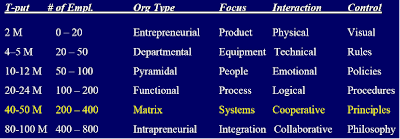
The Corporate Growing Process

I followed the evolution of various private companies, in their early stages, before they become big conglomerates. I noticed substantial similarities, and based on such observation I developed a map indicating the correlation between the main organizational parameters. After consulting with numerous people in different industries, and upon discussing it in a series of forums and functions, I gained enough confidence in its validity to submit it for public review.


My analysis was triggered by Peter Drucker’s assertion that “any organization that doubles or triples in size over a short period of time has necessarily outgrown its theory”. What I found was a series of examples of cyclical evolutions, each being characterized by certain essential attributes: Size (expressed in Throughput or number of employees), Organizational structure, Strategic focus, Mode of interaction and Control mechanisms - to name a few.


Another interesting finding was the realization by consulted experts in the field, that the chart offers not only an evolution map, but also provides answers to problems of dis-functionality and misalignment, as noticed in organizations situated on different stages of development.

Monday, October 13, 2008

Organizational Entropy

According to the second law of thermodynamics, during any process the change in entropy of a system and its surroundings is either zero or positive. In other words the entropy of a closed system tends toward a maximum. I was always wondering if this principle holds true in a business environment.

In its sociological application the concept of entropy is used as a metaphor for chaos, disorder or dissipation of energy. In a company - as a closed system - the energy is conserved. But it tends to degrade from useful forms to useless ones: everybody’s busy but value is not created.

The entropy of an organization is reflected in the amount of energy not converted into work during a process. The more uncertainty in vision, randomness in strategy, or indecision in action, the higher the entropy. Entropy is a measure of the inability of a system’s energy to do useful work; it becomes a measure of the business inefficiency.

Thursday, September 25, 2008

The US Financial Crisis and Other Parallels

I only understand a fraction of the economic impact the experts predict as a result of the banking crisis in the US. And I know I am not the only one feeling this way – including some of the people that are expected to be the ones deciding how to get out of this mess.

What is really puzzling to me is how we all listen to and expect solutions from the same people who allowed this crisis to happen in the first place. How could they be trusted? They either don’t have the expertise or the integrity to be in charge with this recovery.

Unfortunately, this is not the only field where overdependence on few technical experts could be detrimental to an entire system. IT is another example where crisis of a magnitude threatening to paralyze an entire organization could occur. And most of the time we rely on the recommendations of the same people who were responsible to prevent it, and there is nothing we could do but to follow their advice to spend substantial amount of money upgrading or updating, because “the consequence of doing nothing is more costly than the alternative” – didn’t we just hear that from the financial experts of the day?

I guess this is the new way of justifying decisions of “strategic importance” – the war in Iraq (on terror) has been explained this way numerous times. In reality though is just a manipulative exploitation of the human psychology which is by nature risk seeking to gains and risk averse to losses.